When selecting a heat sink for high-power LED systems, cold forged heat sinks are the superior choice for thermal performance and design flexibility, while extruded heat sinks offer a cost-effective solution for lower-power applications. The decision hinges on balancing thermal management requirements, spatial constraints, and budget. For high-power LEDs where reliability and longevity are critical, the enhanced heat dissipation of cold forging justifies its higher initial cost.
Understanding the Critical Role of Heat Sinks in High-Power LED Systems
High-power LEDs convert a significant portion of electricity into light, but the remaining energy becomes heat. Unlike traditional bulbs, LEDs trap heat within the semiconductor junction. If not managed, this heat leads to reduced lumen output, color shifting, and shortened operational life.
The fundamental job of a heat sink is to provide a path for thermal energy to move from the LED chip to the surrounding air. In high-power applications like stadium lighting or automotive headlamps, the heat density is immense. An inadequate thermal solution leads to premature failure.
What Are Extruded Heat Sinks? The Process and Characteristics
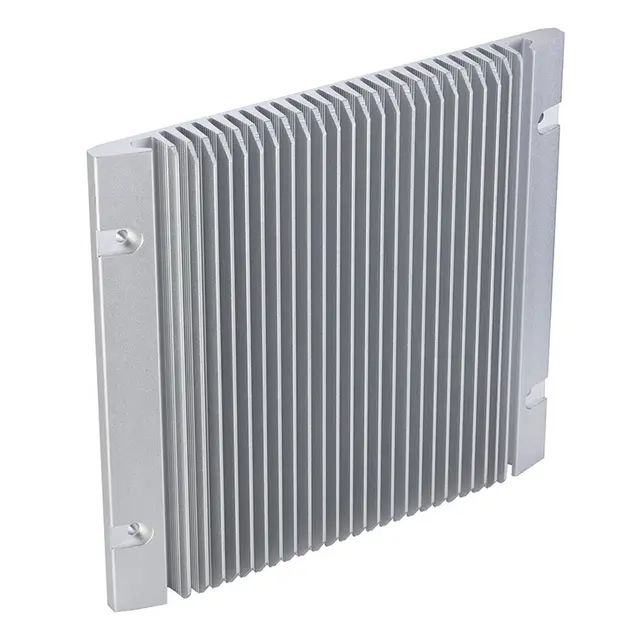
Aluminum extrusion is a mature process where a heated billet of aluminum (typically 6063 or 6061) is forced through a steel die. This creates a continuous profile with fixed cross-sections, characterized by linear, parallel fins.
Advantages and Disadvantages of Extrusion
Advantages: Low tooling cost, high-speed production, and excellent consistency for high-volume orders.
Disadvantages: Inherently two-dimensional (cannot create pin fins), lower thermal conductivity compared to pure aluminum, and limited fin aspect ratios.
What Are Cold Forged Heat Sinks? A Leap in Performance
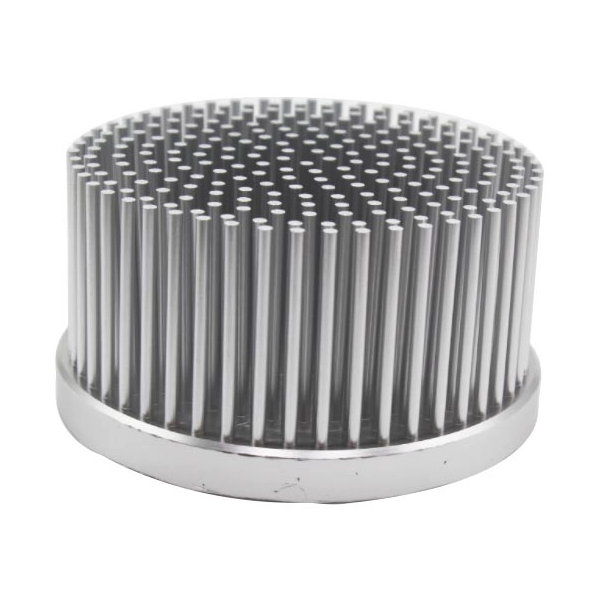
Cold forging is a high-pressure process where a room-temperature slug of pure aluminum (AL1070) is struck by a punch. The metal flows into the die cavity, forming a one-piece heat sink with integrated fins and base.
Advantages and Disadvantages of Cold Forging
Advantages: Uses high-purity aluminum (~227 W/mK), provides 3D design flexibility (round pins), and creates a void-free structure for superior heat travel.
Disadvantages: Higher initial tooling cost and longer cycle times compared to extrusion.
Head-to-Head Comparison: Cold Forged vs. Extruded Heat Sinks
Which offers better Thermal Performance?
Cold forging is the clear winner. By using higher-purity aluminum and forming aerodynamically superior shapes like round pins, it creates turbulence that disrupts the thermal boundary layer. This is far more effective for natural convection than linear extruded fins.
Comparative Analysis Table
| Feature |
Cold Forged Heat Sink |
Extruded Heat Sink |
| Thermal Conductivity |
Excellent (227 W/mK) |
Good (200 W/mK) |
| Design Geometry |
3D Complex (Round Pins) |
2D Linear (Parallel Fins) |
| Best Airflow Type |
Omnidirectional / Natural |
Forced / Linear |
| Initial Cost |
Higher |
Lower |
The Verdict: Which Heat Sink Wins for High-Power LED Systems?
For high-power LED systems, the decisive winner is the cold forged heat sink. While extrusion is great for low-to-mid power applications, it cannot compete with the thermal conductivity and design freedom required for COB LEDs or high-bay industrial fixtures. Investing in a cold forged part ensures extended LED life and consistent light quality.
[Back to Top]
Keywords: cold forged heat sink, extruded heat sink, high-power LED cooling, thermal management, aluminum extrusion, COB LED cooling.