Coolant leaks in high-density data centers cause catastrophic hardware failures and millions in downtime. Relying on mechanical seals for high-pressure systems guarantees eventual failure. Vacuum brazed cold plates prevent leaks in AI GPU clusters by using high-temperature metallurgical bonding to fuse metal layers into a seamless, leak-proof monolith.
When liquid cooling transitions from an optional upgrade to a mandatory requirement for next-generation silicon, the tolerance for mechanical failure drops to absolute zero. Pumping dielectric fluids or water-glycol mixtures directly above densely packed, million-dollar server racks requires structural integrity that traditional manufacturing simply cannot provide. Let us examine the specific metallurgical processes and testing standards that guarantee absolute fluid containment under extreme thermal and pressure loads.
Table of Contents
Why Do Traditional Cold Plates Fail in AI Data Centers?
How Does a Metallurgical Bond Eliminate Leakage Paths?
What Testing Guarantees a Zero Leakage Standard?
How Do Brazed Plates Handle 1000W+ Heat Loads?
Where Are Leak-Proof Cold Plates Deployed Beyond AI?
How Do Quality Systems Ensure Reliable Mass Production?
1. Why Do Traditional Cold Plates Fail in AI Data Centers?
AI server architectures demand continuous, high-pressure fluid flow to manage immense thermal output. Traditional manufacturing techniques struggle to maintain structural integrity under these relentless mechanical and thermal stresses across extended operational lifespans.
Traditional cold plates fail in AI data centers because mechanical seals, O-rings, and epoxied joints degrade over time from thermal cycling and high pump pressures. This degradation creates microscopic pathways that eventually allow conductive coolants to leak onto sensitive electronics.
The Limitations of Mechanical Seals
When evaluating fluid containment, procurement managers must analyze the inherent weaknesses of multi-part assemblies. Traditional cold plates often rely on embedded tubes or two-piece block designs sealed with elastomer O-rings and friction-stir welding. When an AI cluster runs a massive training model, the GPUs cycle from idle to maximum Thermal Design Power (TDP) in seconds. This aggressive thermal cycling causes dissimilar materials to expand and contract at different rates, a phenomenon known as Coefficient of Thermal Expansion (CTE) mismatch.
Over thousands of cycles, this micro-movement crushes O-rings and fractures thermal epoxies. For example, in standard enterprise servers, a slow weep from a degraded O-ring might be mitigated by absorbent pads or leak detection cables before causing a short circuit. However, in a densely packed AI GPU cooling environment, pump pressures are significantly higher to force fluid through restrictive micro-channels. A pressurized leak from a failed mechanical joint in a 4U server chassis instantly sprays conductive coolant across multiple $30,000 accelerators, causing cascading hardware destruction.
Design Trade-off: Mechanical seals offer lower initial tooling costs but carry unacceptable long-term risks for high-value silicon.
Practical Advice: Never specify elastomer seals for internal cold plate channels in environments experiencing $\Delta T$ shifts greater than 40°C per minute.
2. How Does a Metallurgical Bond Eliminate Leakage Paths?
To achieve true leak-proof cold plates, the manufacturing process must move beyond mechanical fastening and polymer sealants. The solution lies in fundamentally altering the material structure at the absolute molecular level.
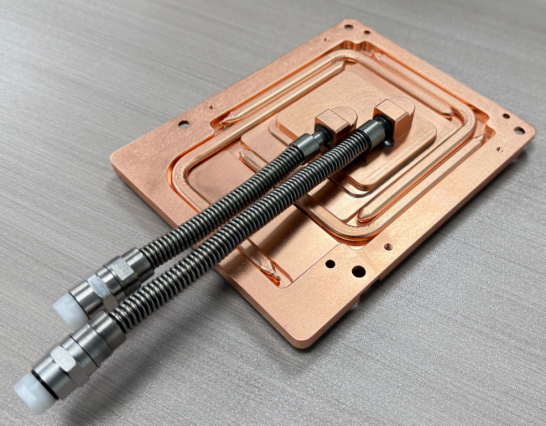
A metallurgical bond eliminates leakage paths by melting a filler alloy between precisely machined base plates inside a vacuum furnace. Capillary action draws the liquid metal across every internal surface, creating a seamless, single-piece structure with no joints to fail.
The Vacuum Brazing Process
Creating a leak-proof cold plate requires deep brazing expertise. The process begins by CNC machining intricate flow channels into an aluminum or copper base. A clad brazing sheet—a specialized filler metal—is placed between the base and the cover plate. The entire assembly is loaded into a high-vacuum furnace and heated to temperatures approaching the melting point of the base metals. In the absence of oxygen, the filler metal melts and flows flawlessly via capillary action into every microscopic crevice between the plates and internal fins.
This creates a true metallurgical bond. The resulting cold plate is no longer two pieces held together; it is a single, continuous block of metal. For instance, AI GPU cooling requires complex internal micro-channels to maximize surface area. Brazing fuses the tops of these ultra-thin fins directly to the cover plate, adding immense structural rigidity. In supercomputers operating with direct-to-chip liquid cooling, this monolithic strength allows the cold plate to easily withstand hydraulic shock and pump surges that would instantly rupture a standard epoxied seam. Since 2009, Winshare Thermal has cultivated this deep brazing expertise, mastering complex flow channels and multi-material combinations to ensure unmatched sealing in the most hostile server environments.
Manufacturing Method | Joint Type | Leak Risk | Pressure Tolerance |
O-Ring & Screws | Mechanical | High over time | Low to Moderate |
Friction Stir Welding | Solid-state physical | Moderate (pinhole risks) | Moderate |
Vacuum Brazing | Metallurgical Bond | Absolute Minimum | Extremely High |
3. What Testing Guarantees a Zero Leakage Standard?
Visual inspections and standard water pressure tests are insufficient for protecting million-dollar AI infrastructure. Proving an absolute zero leakage target requires utilizing the most highly sensitive molecular detection equipment currently available.
A zero leakage standard is guaranteed by utilizing Helium mass spectrometry leak detection. Because helium molecules are exceptionally small, forcing them into the cold plate in a vacuum chamber allows sensors to detect microscopic porosities that liquids would take months to penetrate.
Strict Non-Destructive Testing Protocols
Engineering a flawless metallurgical bond is only half the equation; validating it requires strict non-destructive testing (NDT). Relying solely on pneumatic underwater bubble testing or hydrostatic burst tests only confirms macro-level strength. To achieve an absolute zero leakage target, manufacturers must identify flaws at the atomic level before the product leaves the facility.
Helium mass spectrometry leak detection is the gold standard for this validation. Helium is an inert gas with an incredibly small atomic radius. During testing, the brazed cold plate is placed inside a hard vacuum chamber and charged internally with high-pressure helium. A mass spectrometer acts as a highly sensitive "sniffer" inside the chamber. If even a single atom of helium escapes through a microscopic pinhole in the brazed joint, the spectrometer detects it.
Consider data center servers utilizing two-phase immersion or direct-to-chip cooling; these systems cannot tolerate even a microscopic vapor leak. Helium testing detects leak rates as small as $10^{-9}$ atm cc/sec. Similarly, liquid-cooled network switches positioned at the top of a server rack must have absolute fluid containment, as gravity would turn a single escaping drop into a multi-server short circuit. By implementing this extreme level of quality control, Winshare ensures that every dispatched unit meets the zero-leakage mandate required by top-tier data centers.
4. How Do Brazed Plates Handle 1000W+ Heat Loads?
Modern AI accelerators consume staggering amounts of electrical power. Safely dissipating this energy requires maximizing the internal surface area without compromising the structural integrity of the fluid channels during intense operation.
Brazed plates handle 1000 W+ heat loads by utilizing densely packed internal micro-channels or skived fins that are metallurgically fused to the heat source contact area. This maximizes surface area and minimizes thermal resistance, rapidly extracting extreme high heat fluxes.
Optimizing Flow Channels for AI Servers
Dissipating extreme heat is a function of surface area and fluid velocity. AI GPU cooling is not just about moving fluid; it is about moving fluid through massive, highly optimized internal geometries. As thermal densities scale, the internal fins must become thinner and packed closer together.
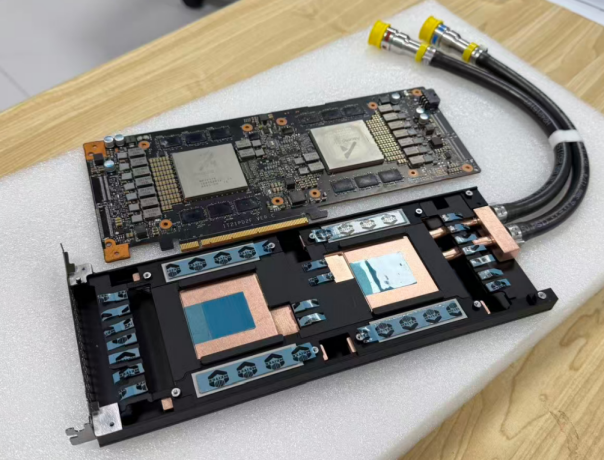
Next-generation GPU clusters operate at over 1000 W+ per chip. To manage this extreme heat flux, we design cold plates with offset strip fins or ultra-dense micro-channels. Vacuum brazing allows us to fuse these intricate fin arrays directly to the top and bottom plates. Because the metallurgical bond eliminates all contact resistance, the fins themselves become highly efficient, active heat spreaders. In high-performance computing (HPC) environments, CPUs and memory modules require these tightly pitched micro-channels precisely aligned over the silicon dies to manage severe localized hotspots.
The structural rigidity provided by the brazing process also means engineers can safely push much higher fluid flow rates through the plate without bending or damaging the delicate internal fins.
Map the Die Location: Align the densest fin pitch directly underneath the highest heat-generating zones of the silicon.
Optimize Pressure Drop: Balance the dense micro-channels with optimized manifold designs to ensure the data center pumps are not overworked.
Validate Thermal Resistance: Ensure the $\Delta T$ from the component junction to the fluid inlet remains well below the throttling threshold.
5. Where Are Leak-Proof Cold Plates Deployed Beyond AI?
The absolute reliability demanded by modern data centers is equally critical in other high-stakes industries. The exact same brazing technology protects critical infrastructure across various extreme environments and volatile pressure conditions.
Beyond AI, leak-proof cold plates are widely deployed in wind power converters, EV motor controllers, and advanced medical imaging equipment like MRI and CT scanners. These specific applications require absolute fluid containment to prevent electrical shorts in high-voltage, high-vibration environments.
Validating Reliability in Extreme Environments
The metallurgical integrity proven in supercomputers translates directly to heavy industrial applications. The core requirement remains identical: absolute reliability where maintenance is either impossible, dangerous, or prohibitively expensive.
For example, wind power converters sit atop 100-meter towers in offshore installations. Servicing a leaked cooling system in this environment is incredibly costly. Vacuum brazed cold plates are utilized here to handle the massive current switching of IGBTs, withstanding constant, high-frequency mechanical vibration from the turbine without fracturing. Similarly, advanced medical imaging equipment, such as MRI and CT scanners, requires exact thermal control for their power electronics to produce clear, artifact-free images. A coolant leak inside an MRI room not only destroys a multi-million dollar medical asset but poses severe safety risks.
This cross-industry validation is crucial for procurement teams. The fact that this technology successfully manages the high pressures of wind turbines and the strict safety mandates of medical devices perfectly illustrates its durability. It is exactly this proven reliability across extreme use cases that has established Winshare as the preferred partner of many global leading companies operating in the high heat flux thermal management sector.
6. How Do Quality Systems Ensure Reliable Mass Production?
Prototyping a single leak-proof cold plate is an engineering challenge; manufacturing ten thousand identical, flawless units requires an uncompromising, heavily audited operational framework and a deeply ingrained corporate quality culture.
Reliable mass production is directly ensured through strict adherence to ISO 9001 and TS 16949 quality management systems. These robust frameworks mandate rigorous process controls, traceable material sourcing, and continuous automated inspections to guarantee every single cold plate meets zero-leakage specifications.
Certified Manufacturing Excellence
Scaling up from a successful prototype to outfitting entire GPU clusters requires automotive-level process control. A single manufacturing defect out of a thousand plates can bring down a server rack. To prevent this, elite thermal manufacturers rely on globally recognized quality frameworks.
By strictly adhering to ISO 9001 and TS 16949 (now IATF 16949) standards, every variable in the factory is locked down. TS 16949 methodologies, originally designed for automotive safety components, require Statistical Process Control (SPC). This means the temperature, vacuum pressure, and cycle times of our brazing furnaces are monitored and recorded to the exact degree for every batch. Furthermore, strict material traceability ensures that the aluminum base plates and clad brazing foil used in a specific batch of data center servers can be tracked all the way back to the raw material mill.
When product designers request samples, they are not just evaluating a piece of metal; they are evaluating the factory's ability to repeat that exact geometry flawlessly. Partnering with a certified manufacturer like Winshare Thermal, who has focused exclusively on high-power thermal solutions since 2009, eliminates the supply chain risks associated with inconsistent thermal performance and catastrophic field failures.
Conclusion
In the realm of High-Performance Computing and AI GPU clusters, thermal management is synonymous with risk management. Traditional mechanical assemblies simply cannot provide the safety guarantees required for multi-million dollar silicon deployments. Vacuum brazed cold plates eliminate these risks through a metallurgical bond that fundamentally fuses the assembly into a single, leak-proof structure. Backed by deep brazing expertise and strict non-destructive testing like helium mass spectrometry, these components comfortably manage 1000 W+ heat loads with an absolute zero leakage target. By insisting on ISO 9001 and TS 16949 certified manufacturing, procurement managers can confidently deploy these solutions, knowing the cooling infrastructure will outlast the silicon it protects.
Frequently Asked Questions (FAQ)
1. What is a vacuum brazed cold plate?
It is a liquid cooling device manufactured by placing a filler metal between machined metal plates and heating them in a vacuum furnace until the filler melts, creating a seamless, single-piece monolithic structure.
2. Why is vacuum brazing superior to O-ring seals for AI servers?
O-rings are mechanical elastomer seals that degrade over time due to thermal cycling and high pump pressures. Vacuum brazing creates a metallurgical bond with no physical joints to degrade, guaranteeing zero leaks.
3. What is a metallurgical bond?
A metallurgical bond occurs when the base metals and the filler metal interact at the molecular level during the high-temperature brazing process, effectively welding the components together into a solid piece.
4. How do you test for a "zero leakage" target?
We utilize Helium mass spectrometry leak detection. Helium gas is pumped into the cold plate inside a vacuum chamber; a mass spectrometer then detects if even microscopic traces of the gas escape, ensuring the plate is entirely sealed against liquids.
5. Can brazed cold plates handle heat loads above 1000 W?
Yes. The brazing process allows for the integration of extremely dense internal micro-channels and skived fins directly beneath the heat source. This massive internal surface area is highly efficient at dissipating heat loads exceeding 1000 W+.
 English