As the electric vehicle (EV) industry pushes toward 800V architectures, high-rate fast charging, and CTP (Cell-to-Pack) battery structures, thermal management has evolved from a secondary engineering detail to a mission-critical safety layer. When your battery system operates at higher power densities, the heat generated during rapid energy transfer is no longer a minor hurdle—it is a system-limiting bottleneck that directly dictates vehicle safety, charging stability, and long-term reliability.
In the past, traditional air cooling battery systems were sufficient for lower power demands. However, for modern EV platforms, the shift toward liquid cooling for EV batteries is no longer just an upgrade; it is an industry standard for any platform targeting high-performance charging and high-density packaging. For engineering leads and procurement teams, the decision between cooling technologies isn't just about choosing a heat sink; it is about defining the performance ceiling of your vehicle platform.
1. Why Have Traditional Air Cooling Systems Reached Their Limits?
The primary limitation of air-based thermal management lies in the physical properties of the cooling medium. Air has a very low heat capacity and poor thermal conductivity compared to liquid coolants.
In early EV development, air cooling was adequate because power densities were low, and charging rates were slow. However, as OEMs push for compact battery layouts—often minimizing or eliminating the gaps between cells—there is simply not enough space to move enough air through the pack to carry away heat. When a battery is subjected to the intense thermal load of a high-power fast charge, an air-cooled system cannot extract that energy fast enough. This leads to rapid temperature spikes, localized hotspots, and, in severe cases, increases the risk of thermal runaway. Furthermore, air cooling is highly dependent on ambient temperature, making it notoriously unreliable in extreme weather conditions.
2. How Does Liquid Cooling for EV Batteries Transform Performance?
Liquid cooling systems for EV batteries utilize a water-glycol mixture flowing through engineered cold plates, which are physically mounted to the battery cells. This approach provides significantly higher heat dissipation efficiency because liquid can absorb and transport heat at rates that air systems simply cannot match.
The core advantage of liquid cooling in EVs is its ability to be routed precisely where needed. By integrating an EV battery cold plate into the pack, thermal engineers can ensure that fresh, chilled coolant is delivered to the exact hotspots identified during the design phase. This technology supports:
● High-Power Charging: Allowing the battery to accept higher currents without exceeding temperature limits.
● Compact Packaging: Enabling tighter cell arrangements (CTP/CTC) that boost energy density.
● Uniformity: Achieving much tighter control over battery temperature consistency.
3. Why Is Battery Temperature Consistency the Key to Reliability?
In the design of modern EV battery thermal management, achieving a uniform temperature distribution across the entire pack is just as important as the total heat dissipation capacity.
Uneven heating leads to "outlier cells." If the cells at the coolant inlet are 20°C and the cells at the outlet are 35°C, those warmer cells will experience accelerated chemical degradation. Over thousands of charge-discharge cycles, this uneven aging leads to capacity loss, range reduction, and potentially, dangerous thermal instability.
By optimizing the liquid cooling channels and flow distribution within a custom FSW (Friction Stir Welding) cold plate, OEMs have successfully reduced maximum temperature differences from 8°C down to less than 4°C in real-world battery packs. This improvement is not just a thermal metric; it directly correlates to:
● Extended Battery Lifespan: Approximately 6%–15% improvement in cycle life.
● Higher Charging Efficiency: Roughly 15% improvement in fast-charging performance.
● Safety: Dramatically lower risk of localized thermal runaway.
4. How Do High-Power SiC Inverters Change Thermal Requirements?
The shift to SiC (Silicon Carbide) inverters is a game-changer for EV platforms. While SiC power modules are more efficient than traditional silicon, they generate intense heat in a very small footprint.
Traditional air cooling is categorically unable to manage the power density of modern SiC units. High-performance automotive thermal management solutions must now leverage advanced manufacturing, such as vacuum-brazed cold plates with complex internal microchannels. These solutions can reduce thermal resistance by approximately 30%, allowing the inverter to handle higher switching frequencies and power densities without requiring a larger, heavier footprint. As SiC becomes the industry standard for 800V drive systems, selecting a manufacturer that specializes in both battery plate production and high-power inverter cooling is essential for a unified thermal architecture.
5. What Should You Look for in a Custom EV Battery Cold Plate Manufacturer?
When selecting an EV battery cooling plate manufacturer, you are not just selecting a vendor for hardware; you are choosing a partner for platform validation. The most successful automotive thermal management solutions rely on three pillars of expertise:
I. Automotive-Grade Manufacturing Capabilities
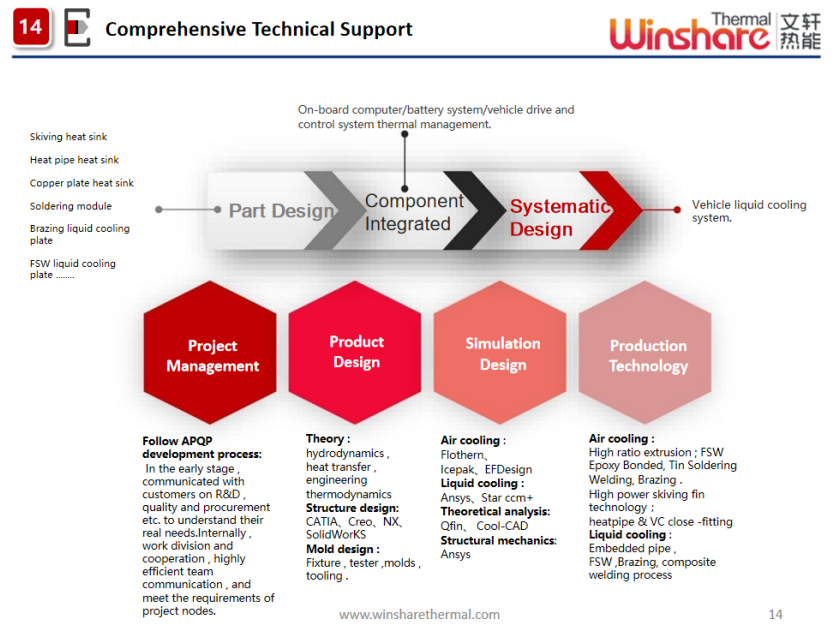
Tier 1 and OEM customers must demand IATF 16949 compliant manufacturing processes. The consistency of the assembly—whether it is FSW, vacuum brazing, or embedded tube technology—is critical. You need a partner that provides documented quality control, including non-destructive testing (such as helium mass spectrometry), to guarantee zero-leak reliability.
II. Advanced Thermal Simulation Support
Do not rely on trial and error. A high-quality manufacturer should provide CFD (Computational Fluid Dynamics) analysis and flow channel optimization. Before any aluminum is cut, you should know exactly how the coolant will distribute across your battery cells. This simulation capability allows you to iterate designs rapidly, saving time during the vehicle validation phase.
III. Proven Industry Experience
Look for a partner with actual project experience in EV battery packs, motor controllers, and power electronics. At Winshare Thermal, we have spent years refining automotive liquid cooling solutions. Our work spans from large-size battery cooling plates to specialized SiC inverter cooling modules. We understand that OEMs don't just want a cooling plate; they want a validated system that passes every thermal runaway test and performance benchmark the first time.
6. Comparison: Cooling Technologies for EV Platforms
Technology | Heat Dissipation | Structural Integrity | Complexity | Best Application |
FSW Liquid Cooling | High | Excellent | Moderate | Large Battery Packs |
Vacuum Brazed | Extreme | High | High | SiC Inverters / ADAS |
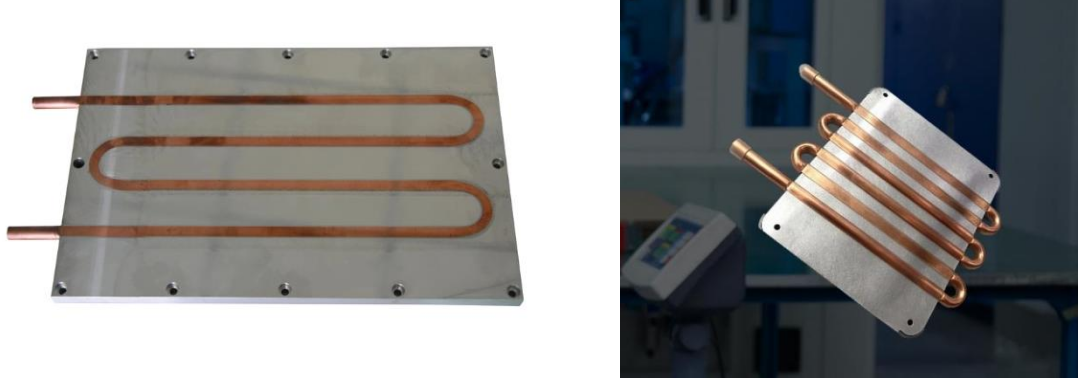
Embedded Tube | Moderate | Moderate | Low | Auxiliary Modules |
Die-Cast Liquid | Moderate | High | Moderate | Motor Controllers |
As shown above, the choice of technology depends on your specific heat flux requirements. For large battery packs, FSW cold plates are often the industry preference due to their lightweight and robust nature. For compact, high-power electronics like inverters, vacuum-brazed designs are frequently required.
Conclusion: Securing Your EV Thermal Strategy
The transition to high-performance liquid cooling is a strategic necessity for any modern EV platform. As vehicle architectures continue to favor high energy density, fast charging, and compact integration, the role of an expert automotive thermal management solution provider becomes a key competitive advantage.
A reliable cooling system is not just about moving heat; it is about guaranteeing the vehicle's safety, longevity, and fast-charging stability. When choosing your thermal partner, prioritize those who offer a blend of automotive-grade manufacturing, advanced simulation, and diverse technological expertise.
At Winshare Thermal, we are dedicated to helping OEMs and Tier 1 suppliers solve their most difficult thermal challenges. From initial thermal structure design and flow optimization to the high-volume production of FSW and brazed plates, our engineering team is ready to support your next project.
Are you currently facing thermal hotspots or charging efficiency bottlenecks in your battery pack design? [Contact our engineering team today] to request a thermal simulation analysis or to discuss a custom cooling architecture that meets your specific EV platform requirements.
Frequently Asked Questions (FAQ)
1. Why is liquid cooling considered safer than air cooling for EVs?
Liquid cooling can extract heat far more effectively, which prevents localized hotspots where cells might exceed safe temperature limits. By maintaining uniform temperature consistency, liquid systems drastically reduce the risk of thermal runaway, making the entire vehicle safer.
2. What is an FSW cold plate?
FSW stands for Friction Stir Welding. It is a solid-state welding process used to seal the cooling channels within an aluminum cold plate. It creates an incredibly strong, lightweight, and leak-proof structure, which is ideal for the structural demands of EV battery packs.
3. How does liquid cooling affect battery lifespan?
Batteries degrade faster when exposed to high, uneven temperatures. Liquid cooling systems maintain an optimal, uniform temperature range, which industry data suggests can extend the battery's cycle life by 6% to 15%.
4. Why do SiC inverters require specialized cooling?
SiC inverters operate at higher power densities than traditional silicon components. They generate intense, concentrated heat that traditional cooling solutions struggle to handle. Specialized brazed cooling plates allow SiC inverters to run efficiently without throttling.
5. How can thermal simulation reduce development risk?
Thermal simulation (CFD) allows engineers to model the thermal performance of a cooling plate design before manufacturing. This identifies potential hotspots and flow issues early, reducing the need for costly physical prototypes and redesigns.
6. Is liquid cooling complicated to maintain?
Modern automotive liquid cooling systems are designed for the vehicle's lifespan. They are closed-loop systems that require no routine maintenance under normal operating conditions. High-quality plates are manufactured to be hermetically sealed, preventing any leakage concerns.
7. Can an EV battery cooling plate be customized?
Absolutely. In fact, most high-performance battery packs require custom cold plates. A capable manufacturer, such as Winshare Thermal, will tailor the channel layout, plate size, and material selection to fit your specific pack geometry and heat load.