Thermal bottlenecks in restricted spaces destroy high-power electronics. Relying on standard extrusions for extreme heat fluxes inevitably leads to system failure. Skived fin heat sinks are better for high-density cooling than extruded heat sinks because their single-piece construction and ultra-thin, closely spaced fins maximize surface area and eliminate thermal interface resistance.
As power densities in modern electronics skyrocket, mechanical and thermal engineers face a constant battle against physical space constraints. Whether you are designing a compact EV charger or a densely packed computing cluster, squeezing more heat dissipation out of the exact same footprint is the ultimate challenge. At Winshare Thermal Technology Co., Ltd., we see procurement and design teams repeatedly hit the physical limits of traditional manufacturing. Let us dive into the mechanical realities of these two distinct manufacturing processes to help you make the right structural decision for your next high-power project.
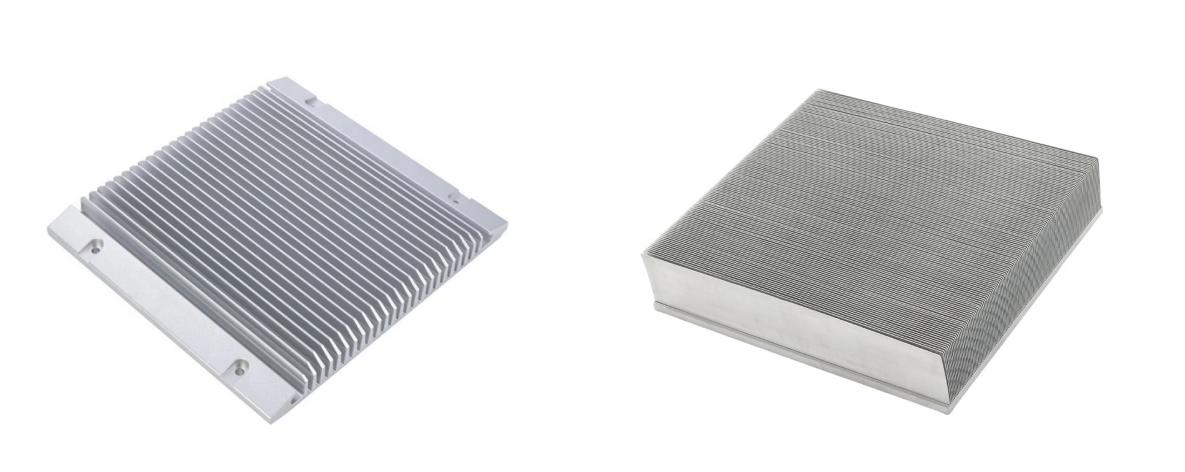
Table of Contents
What Are the Physical Limitations of Extruded Heat Sinks?
How Does the Skiving Process Break Through Density Barriers?
Why is a Single-Piece Construction Crucial for Thermal Resistance?
What Are the Extreme Physical Parameters of Skived Fins?
How Do Tooling Costs and Flexibility Compare?
Which Heat Sinks Are Best for High Performance Computing?
How Do Skived Heat Sinks Protect Power Electronics?
1. What Are the Physical Limitations of Extruded Heat Sinks?
The manufacturing method directly dictates the maximum cooling capacity of the final component. Relying on outdated processes restricts your ability to dissipate modern thermal loads.
Extruded heat sinks are limited by die strength, which restricts fin density and maximum height. Additionally, they require a taper draft angle to release from the mold, preventing engineers from maximizing the available cooling surface area within tight spatial constraints.
Engineering Bottlenecks in the Extrusion Process
The traditional extrusion process involves forcing a heated, softened billet of aluminum through a hardened steel die under immense hydraulic pressure. The die contains thin, hollow "fingers" that shape the gaps between the fins.
From a mechanical engineering perspective, this creates a severe physical bottleneck. If the design calls for extremely thin fins packed closely together, the steel fingers inside the die become too fragile and will snap under the pressure of the flowing aluminum. Therefore, extruded heat sinks must maintain a relatively wide fin gap and a thicker fin base.
Furthermore, a taper (or draft angle) is required. The fin must be thicker at the base and thinner at the top so it can be successfully pulled away from the mold without tearing the metal. This taper wastes valuable volumetric space that could otherwise be used for active cooling surface area.
Applications Limited by Extrusion:
High-Power LED Arrays: Often outgrow standard extrusions, causing lumen depreciation from overheating.
Dense Motor Drives: The wide fin pitch of extrusions fails to capture localized heat spikes.
While perfectly fine for standard consumer electronics, the inherent die strength limitations of extrusion make it an inadequate choice when transitioning to high-density cooling.
2. How Does the Skiving Process Break Through Density Barriers?
Overcoming the extrusion bottleneck requires changing how the metal is manipulated. Removing the mold from the equation entirely unlocks an entirely new tier of thermal performance.
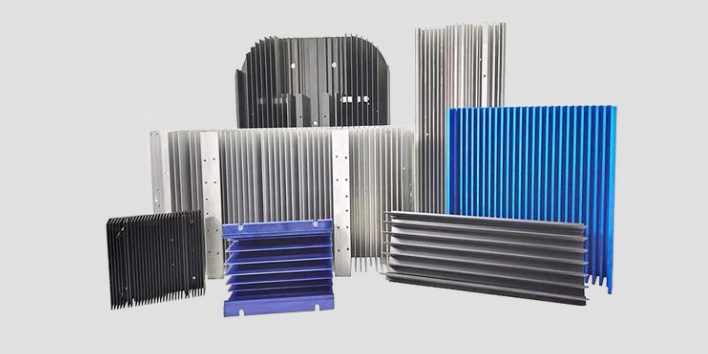
The skiving advantage lies in using precision cutting tools to slice fins directly from a solid metal block. This process entirely eliminates mold restrictions, allowing for unprecedented fin density, extreme aspect ratios, and maximum surface area for high-density cooling applications.
Precision Machining vs Extrusion Dynamics
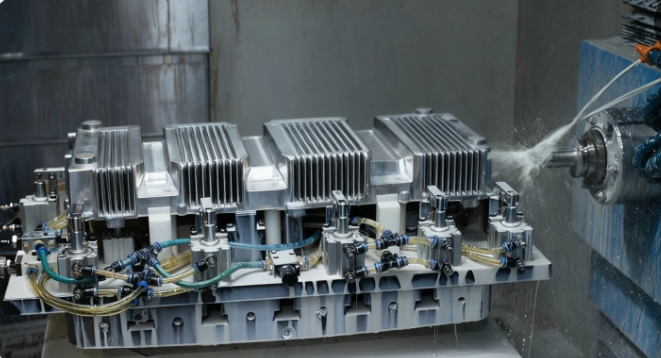
Instead of pushing hot metal through a restrictive shape, the skiving process acts more like a high-precision mechanical planer. A specialized CNC machine utilizes an extremely sharp, wide cutting blade that strikes a solid block of pure aluminum or copper at a shallow angle.
The tool peels up a thin layer of metal, but rather than removing it completely like a standard milling chip, it folds the slice upright to a perfect 90-degree angle, forming a fin. Because there is no steel die involved, the limitations of "die strength" vanish. The machine can step back a fraction of a millimeter and peel up the next fin right beside it.
Multi-Angle Analysis of the Skiving Advantage:
Geometrical: Allows for perfectly straight fins with zero taper, maximizing the cooling surface area within a restricted bounding box.
Material: Extrusions rely heavily on Aluminum 6063 because it is soft enough to flow. Skiving can easily process pure Copper (C1100), which has vastly superior thermal conductivity.
Fluid Dynamic: The micro-roughness created on the fin surface by the skiving blade actually induces slight fluid turbulence, enhancing the convective heat transfer coefficient.
Feature | Extruded Heat Sinks | Skived Fin Heat Sinks |
Manufacturing Method | Forced through a die | Precision sliced from solid block |
Fin Geometry | Tapered (Draft angle required) | Perfectly straight and parallel |
Material Options | Primarily Aluminum alloys | Aluminum, Pure Copper |
3. Why is a Single-Piece Construction Crucial for Thermal Resistance?
In extreme heat flux scenarios, every physical boundary the heat must cross acts as an insulator. High-performance designs must eliminate these boundaries to protect sensitive silicon.
Single-piece construction is crucial because it completely eliminates the contact thermal resistance found in bonded or swaged heat sinks. Since the base and fins are the exact same continuous block of metal, the interface thermal resistance is mathematically zero.
Eliminating the Thermal Interface
When designers realize extruded heat sinks cannot provide enough surface area, they often look to bonded fin or swaged heat sinks. These methods involve machining grooves into a base plate and using thermal epoxy or mechanical pressing to attach separate metal fins.
While this increases fin density, it introduces a severe penalty: interface loss. The microscopic gap between the fin and the base plate—even when filled with high-grade thermal paste—creates a thermal bottleneck. Heat travels efficiently through solid metal, but it slows down drastically when forced to jump across a physical boundary.
Because a skived fin is peeled directly from the base material, it is a single-piece construction. There is no joint, no solder, and no adhesive. The heat generated by the electronic component travels from the base plate up into the fin through a continuous, unbroken crystal lattice of metal.
Examples of Interface Risk:
Laser Diode Cooling: High localized heat fluxes will pool at the bonded joint, causing the diode to overheat and shift its wavelength.
RF Amplifiers: Sudden power spikes require instantaneous heat spreading; bonded joints delay this transfer, risking component burnout. Skiving ensures instantaneous conduction.
4. What Are the Extreme Physical Parameters of Skived Fins?
To truly appreciate the power of skived vs extruded heat sinks, engineers must look at the hard data regarding dimensional limits. The numbers clearly dictate which technology belongs in high-density environments.
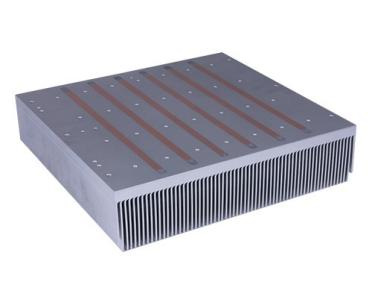
Skived fin heat sinks achieve extreme physical parameters, including fin thicknesses down to 0.2 mm for aluminum and 0.1 mm for pure copper. With gaps as narrow as 0.1 mm and fin heights reaching 150 mm, they provide massive cooling.
Pushing the Limits of Aspect Ratios
The primary metric for comparing heat sink density is the "Aspect Ratio" (the ratio of fin height to the gap between fins). Due to the fragile nature of the tooling, extruded aluminum heat sinks generally max out at an aspect ratio of roughly 10:1 to 12:1.
Skiving shatters this limitation. The process routinely achieves aspect ratios exceeding 50:1. Because the cutting blade dictates the thickness and the CNC stepping motor dictates the gap, the precision is unmatched.
If you have a strict height restriction of 30 mm inside a chassis, an extruded heat sink might only allow for 15 fins across the base. A skived heat sink can pack 45 ultra-thin fins into that exact same space, effectively tripling your heat dissipation area.
Skived Fin Extreme Capabilities Data:
Minimum Fin Thickness: 0.2 mm (Aluminum) / 0.1 mm (Copper)
Minimum Fin Gap: 0.1 mm
Maximum Fin Height: 100 mm to 150 mm
Interface Thermal Resistance: 0.00 °C-in²/W (Zero)
5. How Do Tooling Costs and Flexibility Compare?
Procurement teams must balance thermal requirements with project budgets and go-to-market timelines. Rigid manufacturing processes often lead to expensive delays and sunken capital.
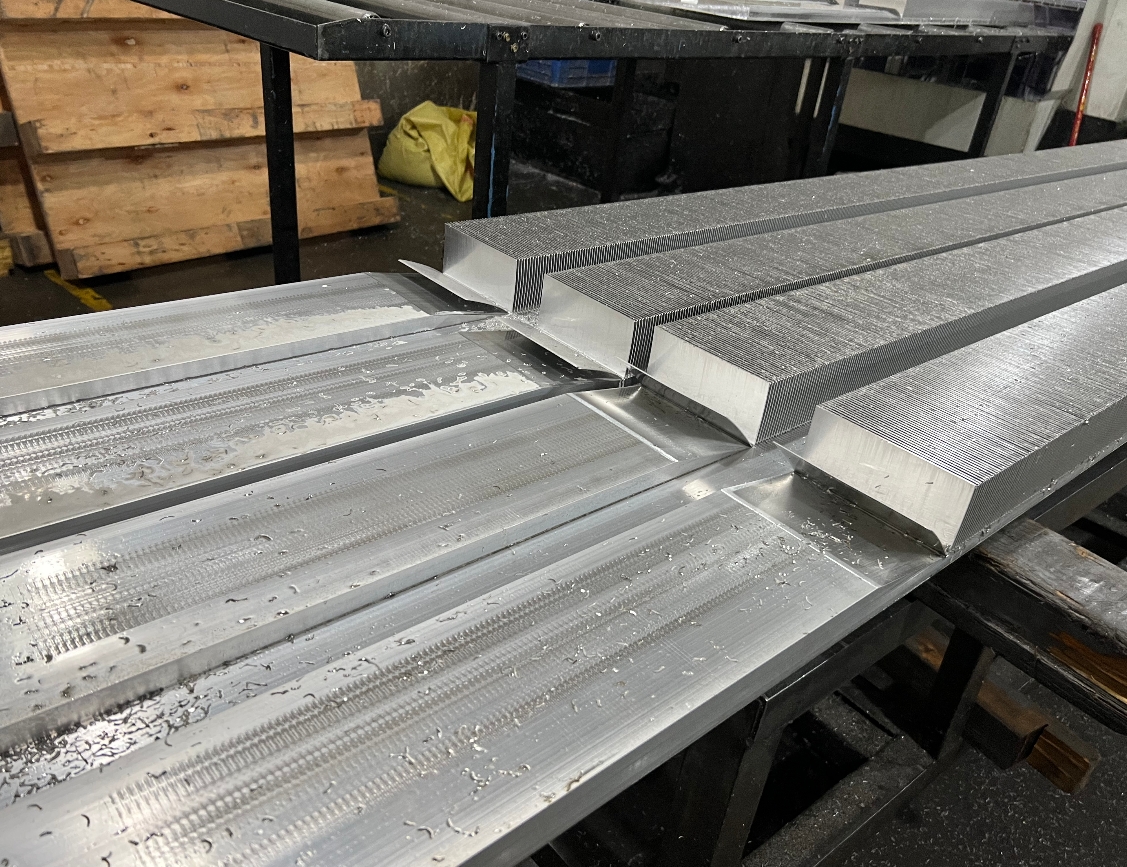
Skived heat sinks offer immense flexibility with zero tooling costs because they do not require expensive custom molds. This results in incredibly fast prototyping cycles and lower startup costs, making them ideal for custom, low-to-medium volume high-density cooling projects.
Financial Trade-offs in Manufacturing
The financial burden of the extrusion process lies in the tooling. Developing a custom extrusion die costs thousands of dollars and typically takes three to four weeks to manufacture and test. Once the die is cut, the design is locked. If thermal testing reveals that the fin pitch needs to be narrowed by 0.5 mm to increase cooling, the original die is useless, and the investment is lost.
Conversely, the skiving process requires no expensive, custom molds. The "tooling" is simply a standard cutting blade and a digital CNC program.
If a product designer needs to test three different fin densities to optimize the airflow from a specific fan, a manufacturer like Winshare Thermal can program the CNC machine to cut three distinct prototypes from the same raw material block on the exact same day.
Design Iteration: Skiving allows for on-the-fly adjustments to fin thickness, gap, and height without financial penalty.
Low Volume Viability: Because there is no tooling amortization required, skiving is highly cost-effective for customized, low-to-medium volume production runs where extrusion minimum order quantities (MOQs) would be prohibitive.
6. Which Heat Sinks Are Best for High Performance Computing?
Data centers are running out of physical space, yet the power consumption of next-generation silicon continues to rise. Standard cooling blocks can no longer keep up with the demands of modern processors.
Skived heat sinks are the best choice for High Performance Computing because they provide the ultra-high fin density required to manage the massive heat generated by CPUs and GPUs within the strictly limited physical space of data centers and laptops.
Managing Heat in Data Centers and Laptops
High Performance Computing (HPC) pushes hardware to the absolute limit. Server racks are designed in standardized "U" heights (e.g., 1U, 2U). A 1U server gives the thermal engineer barely over 40 mm of total vertical clearance. Inside that space, dual CPUs and multiple GPUs are generating hundreds of watts of heat.
Ordinary extruded aluminum cannot provide enough surface area in a 40 mm height to dissipate that load. Furthermore, aluminum's thermal conductivity (∼200 W/m·K) is often insufficient for rapid heat spreading.
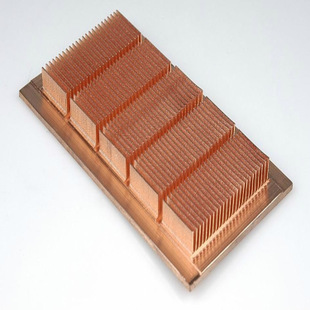
Skiving solves both issues. By utilizing pure copper (∼390 W/m·K) and skiving the fins to an extreme density, the heat sink draws the heat away from the silicon die almost twice as fast and dissipates it across a massive surface area.
HPC Application Examples:
Blade Servers: Dense copper skived heat sinks are mandatory for cooling 300W+ server CPUs operating in highly restricted airflow corridors.
High-End Gaming Laptops: With chassis thicknesses shrinking below 20 mm, manufacturers rely on extremely short, ultra-dense skived copper arrays connected to heat pipes to exhaust GPU heat laterally out of the chassis.
7. How Do Skived Heat Sinks Protect Power Electronics?
Industrial power conversion involves switching massive amounts of current. The resulting thermal spikes will destroy standard semiconductor packages if not managed with high-performance heat sinks.
Skived fin heat sinks protect power electronics by rapidly dissipating extreme thermal loads without interface loss. When heat fluxes in IGBTs, EV chargers, and wind power converters exceed extrusion limits, skived designs become mandatory to maintain stable, continuous equipment operation.
Cooling Renewable Energy and Automotive Systems
The realm of Power Electronics is defined by extreme reliability requirements. Components like Insulated-Gate Bipolar Transistors (IGBTs) are the core switching mechanisms in heavy-duty applications. Unlike a laptop CPU that might throttle down if it gets too hot, an IGBT in a wind turbine or an EV motor controller must maintain continuous, stable operation under relentless high loads.
When an IGBT switches, it generates intense, highly localized heat. If the heat sink directly beneath it cannot pull that heat away instantly, the silicon junction melts. When the heat flow density exceeds the handling capacity of a standard extruded profile, engineers specify skived fin heat sinks.
The single-piece construction guarantees that there is no thermal interface loss blocking the heat from escaping the IGBT baseplate.
Critical Power Electronics Deployments:
EV DC Fast Chargers: High-density skived fins manage the immense heat generated during 350kW+ rapid charging cycles, keeping the rectifier modules stable.
Wind Power Converters: The ultra-high surface area of skived fins ensures that the massive inverters operating in hot, enclosed nacelles do not suffer from thermal degradation over their 20-year lifespans.
At Winshare Thermal, our certified manufacturing processes ensure that these dense, high-performance skived heat sinks meet the rigorous reliability standards demanded by global leaders in the automotive and renewable energy sectors.
Conclusion
The debate between skived vs extruded heat sinks ultimately comes down to thermal density and spatial constraints. While extrusion remains a viable, low-cost method for basic, low-power applications, it hits a hard physical ceiling when deployed in demanding environments. Skived fin heat sinks break through this ceiling. By offering a single-piece construction that eliminates interface loss, and physical parameters that allow for extreme fin densities and high aspect ratios, skiving provides the massive surface area necessary for high-density cooling. Whether you are protecting massive IGBT modules in wind power converters or managing the localized heat of HPC processors, choosing a skived heat sink ensures maximum thermal extraction, rapid prototyping flexibility, and long-term system reliability.
Frequently Asked Questions (FAQ)
1. What is the main difference between skived and extruded heat sinks?
Extruded heat sinks are formed by pushing hot aluminum through a steel die, which limits how thin and close together the fins can be. Skived heat sinks are manufactured by precisely slicing fins directly from a solid metal block, allowing for much higher fin density and thinner fins.
2. Why do extruded heat sinks have a draft angle (taper)?
A draft angle is required in the extrusion process so the aluminum can smoothly release from the steel mold without tearing. Skived fins are cut directly from the block, so they are perfectly straight and require no taper, maximizing surface area.
3. What is interface thermal resistance, and how does skiving eliminate it?
Interface thermal resistance occurs when heat must jump across a gap or bonding material between two separate pieces of metal (like glued-on fins). Skiving eliminates this because the base and the fins are carved from the exact same continuous solid block of metal.
4. Can skived heat sinks be made of copper?
Yes. While the extrusion process struggles with pure copper due to its physical properties, the skiving process easily cuts solid pure copper blocks, providing superior thermal conductivity for extremely high-heat applications.
5. Are skived heat sinks more expensive than extruded ones?
For mass production of simple shapes, extrusion is cheaper per unit. However, skiving has zero custom tooling costs (no expensive molds to buy), making it significantly cheaper and faster for custom prototypes and low-to-medium volume runs.
6. What is the thinnest fin a skiving machine can produce?
Advanced skiving processes can produce aluminum fins as thin as 0.2 mm and pure copper fins as thin as 0.1 mm, allowing for incredibly dense packing of fins within a small space.
 English