When engineering high-power electronics, a fraction of a degree in thermal resistance can be the difference between stable operation and catastrophic system failure. As power densities skyrocket in modern applications, traditional cooling methods are hitting a hard physical wall. Brazed cold plates minimize thermal resistance through a vacuum-brazed monolithic structure that eliminates interface gaps, combined with internal microchannels that maximize the fluid contact area to manage extreme 1000W+ heat loads.
For thermal engineers and procurement managers, solving the high heat flux bottleneck requires moving beyond standard cooling blocks. The true performance of a liquid cooling system does not rely solely on the base material; it fundamentally depends on the internal structural design and the integrity of the manufacturing process. Let us explore the engineering mechanics behind vacuum brazed cold plates and why they are the definitive solution for high-density thermal management.
1. The Core Challenge: High Heat Flux in Modern Electronics
The primary challenge in advanced electronics is the rapid concentration of thermal energy. Components are shrinking, yet their power outputs are multiplying, leading to an exponential rise in heat flux (the amount of heat transferred per unit area).
In these extreme environments, standard air cooling cannot capture and move the heat fast enough. The junction temperatures of silicon dies quickly exceed safe operational thresholds, triggering thermal throttling or permanent degradation. Engineers must implement liquid cooling, but not all liquid cold plates are capable of handling these intense, localized thermal spikes. The system requires a thermal path with the absolute minimum possible resistance from the heat source into the circulating coolant.
2. Why Brazed Cold Plates Outperform Embedded Tube Designs
When evaluating liquid cooling options, the structural differences between embedded tubes and vacuum brazed plates dictate their performance ceilings.
In an embedded tube cold plate, copper or stainless steel tubes are mechanically pressed into grooves cut into an aluminum base. While cost-effective for medium-power applications, this method introduces an inherent flaw for high-power scenarios: interface thermal resistance. The heat must travel through the aluminum base, cross a microscopic mechanical gap (often filled with thermal epoxy), penetrate the tube wall, and finally reach the fluid. Every boundary acts as a thermal insulator.
Conversely, a vacuum brazed cold plate eliminates these boundaries entirely. Multiple layers of precision-machined metal are heated in a high-vacuum furnace until a filler alloy melts and fuses them together. This creates a monolithic, fully sealed structure characterized by low-resistance joints. Direct metal-to-metal continuity ensures that heat flows seamlessly from the component baseplate directly into the fluid channels without the bottleneck of a mechanical interface.
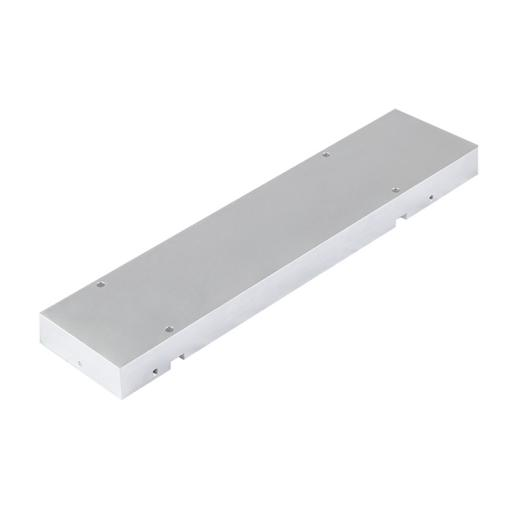
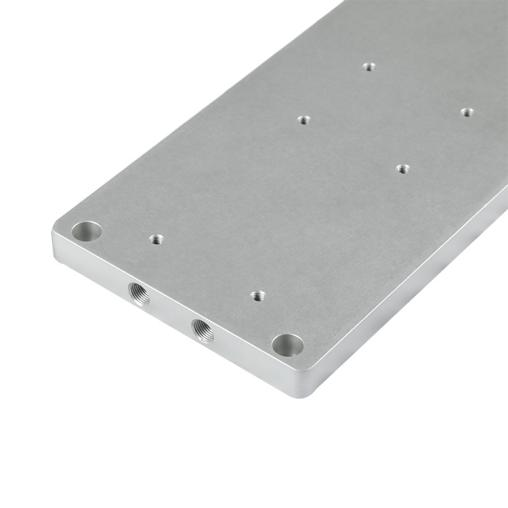
Brazed Cold Plates
3. The Secret to Low Thermal Resistance: Structure and Bonding
From an engineering perspective, optimizing the thermal resistance of a brazed cold plate is not achieved merely by switching to a more conductive raw material. It is achieved through the synergy of internal design and process integrity.
The core advantage of vacuum brazing is that it allows for a full metal bond across complex internal geometries. Because the plates are fused at a metallurgical level, the structural integrity of the cold plate is immense. This allows engineers to hollow out the interior to create highly specialized flow paths without compromising the plate's ability to withstand high fluid pressures. Therefore, the thermal resistance profile is entirely design-dependent, allowing for customized heat extraction precisely mapped to the hotspots of your specific PCB or module.
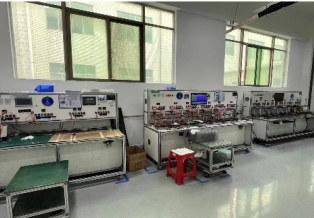
Thermal Resistance Test
4. Maximizing Heat Transfer with Microchannels and Dense Fins
The most critical factor in liquid heat exchange is the surface area exposed to the coolant. A smooth internal channel provides limited contact.
Brazed cold plates leverage microchannels and high-density fin designs directly beneath the heat source. By packing ultra-thin fins closely together, the surface area in contact with the coolant increases exponentially. This structural optimization directly translates to higher convective heat transfer efficiency.
Furthermore, this manufacturing process unlocks complex flow channel control. Instead of fluid moving in a simple straight line, the internal geometry forces the coolant to navigate precise pathways. This turbulent flow allows the liquid to actively "swirl and grab heat," breaking up stagnant thermal boundary layers and drastically improving the convection coefficient. This is why a well-designed brazed cold plate can effortlessly process 1000W+ heat loads within a remarkably compact footprint.
Feature | Embedded Tube Cold Plate | Vacuum Brazed Cold Plate |
Manufacturing Structure | Metal tubes mechanically pressed into a base plate. | Multiple metal layers fused via vacuum brazing into a single monolith. |
Thermal Interface | High risk of contact resistance at the tube/plate boundary. | Zero gap; utilizes low-resistance metallurgical joints. |
Internal Surface Area | Limited to the inner diameter of the smooth tubes. | Massively expanded via precision microchannels and high-density fins. |
Coolant Flow Dynamics | Generally linear, laminar flow. | Complex, customizable routing; turbulent "swirl and grab" capability. |
Heat Load Capacity | Moderate (Suitable for balanced, distributed heat). | Extreme (Capable of safely handling 1000W+ localized heat loads). |
Ideal Application | Cost-sensitive commercial equipment, standard power supplies. | High heat flux environments (AI servers, EVs, IGBTs). |
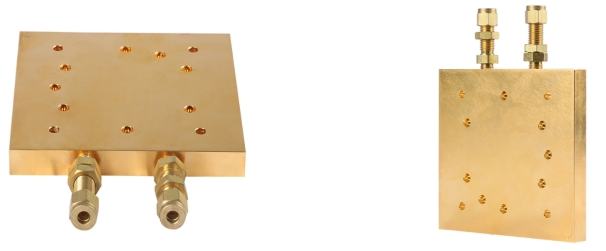
Copper Brazing Cold Plates
5. Real-World Application: Cooling AI Servers and GPU Clusters
The theoretical advantages of brazed cold plates are proven daily in data centers. In the realm of High-Performance Computing (HPC) and AI GPU clusters, system architects face a cascading series of thermal problems:
● The heat flux per unit area of next-generation AI accelerators is rising rapidly.
● Traditional forced-air cooling cannot physically push enough CFM (Cubic Feet per Minute) to cover localized hot spots.
● Legacy cold plate structures, like embedded tubes, hit a thermal resistance bottleneck, failing to extract heat fast enough to prevent CPU/GPU throttling.
(AMD Server Liquid Cooling Components for CPU (SP7 Socket))
The Brazed Cold Plate Solution:
By transitioning to a vacuum brazed architecture, data centers immediately overcome these limitations. The high-density microchannel structures ensure that the fluid contact area is maximized exactly where the GPU dies sit. The complex flow design improves fluid distribution, actively washing away localized hot spots. Most importantly, the vacuum brazed full-metal bond eliminates interfacial gaps, maintaining uninterrupted thermal conductivity.
The Result:
● More stable, precise temperature control across the entire server rack.
● The ability to support a significantly higher power density per U-space.
● Sustained, unthrottled computing performance for continuous AI training workloads.
6. Expanding the Limits in EV, IGBT, and Medical Applications
The requirement for high-density, low-resistance cooling extends far beyond the data center. The same fundamental design principles—microchannels paired with flawless brazed joints—are critical in other heavy-duty industries:
● EV Drivetrains & Battery Systems: Managing the massive thermal spikes during rapid acceleration and DC fast charging.
● High Power Electronics & IGBT Modules: Extracting concentrated heat from power converters in wind turbines and industrial drives to prevent semiconductor melting.
● Laser & Medical Equipment: Maintaining ultra-precise temperature stability for high-power surgical lasers and MRI imaging components.
In all these scenarios, when the heat flow density exceeds the handling capacity of ordinary heat sinks, the low thermal resistance of a brazed plate is the only reliable safeguard.
7. Partnering for Custom Thermal Solutions
Because the thermal resistance of a brazed cold plate is inherently design-dependent, off-the-shelf solutions rarely provide optimal performance for high heat flux applications. At Winshare Thermal, we leverage our deep expertise in vacuum brazing and thermal-fluid simulation to engineer cold plates that match your exact power profiles. By meticulously designing the internal microchannels and ensuring absolute process integrity during bonding, we deliver zero-leakage, high-performance thermal management systems. If your current cooling infrastructure is throttling your innovation, contact our engineering team to design a custom liquid cooling solution tailored to your operational demands.
Frequently Asked Questions (FAQ)
1. What determines the thermal resistance of a brazed cold plate?
Thermal resistance is fundamentally determined by the internal structure design (the density and layout of microchannels or fins) and the integrity of the manufacturing process (achieving a flawless, full-metal bond without gaps).
2. Why is vacuum brazing better than pressing tubes into a plate?
Pressing tubes leaves microscopic gaps and relies on dissimilar materials, creating thermal interface resistance. Vacuum brazing fuses the layers into a single piece of metal, creating low-resistance joints that conduct heat much faster.
3. How much heat can a brazed cold plate handle?
Due to their massive internal surface area and excellent structural integrity, specialized brazed cold plates can be engineered to handle extreme, highly concentrated heat loads exceeding 1000W+.
4. What is a microchannel, and why does it matter?
Microchannels are incredibly thin, precision-machined pathways inside the cold plate. They matter because they drastically increase the surface area that the cooling liquid touches, leading to highly efficient convective heat transfer.
5. Are brazed cold plates suitable for AI data centers?
Yes. They are specifically designed for high heat flux scenarios. They provide the necessary heat extraction rates to keep high-power GPUs and CPUs stable without throttling, making them ideal for HPC and AI applications.
6. How does the internal flow channel design affect cooling?
A well-designed flow channel creates turbulence, allowing the fluid to "swirl and grab heat" rather than just flowing straight through. It also ensures the coldest fluid is routed directly beneath the hottest components on the board.
When engineering high-power electronics, a fraction of a degree in thermal resistance can be the difference between stable operation and catastrophic system failure. As power densities skyrocket in modern applications, traditional cooling methods are hitting a hard physical wall. Brazed cold plates minimize thermal resistance through a vacuum-brazed monolithic structure that eliminates interface gaps, combined with internal microchannels that maximize the fluid contact area to manage extreme 1000W+ heat loads.
For thermal engineers and procurement managers, solving the high heat flux bottleneck requires moving beyond standard cooling blocks. The true performance of a liquid cooling system does not rely solely on the base material; it fundamentally depends on the internal structural design and the integrity of the manufacturing process. Let us explore the engineering mechanics behind vacuum brazed cold plates and why they are the definitive solution for high-density thermal management.
1. The Core Challenge: High Heat Flux in Modern Electronics
The primary challenge in advanced electronics is the rapid concentration of thermal energy. Components are shrinking, yet their power outputs are multiplying, leading to an exponential rise in heat flux (the amount of heat transferred per unit area).
In these extreme environments, standard air cooling cannot capture and move the heat fast enough. The junction temperatures of silicon dies quickly exceed safe operational thresholds, triggering thermal throttling or permanent degradation. Engineers must implement liquid cooling, but not all liquid cold plates are capable of handling these intense, localized thermal spikes. The system requires a thermal path with the absolute minimum possible resistance from the heat source into the circulating coolant.
2. Why Brazed Cold Plates Outperform Embedded Tube Designs
When evaluating liquid cooling options, the structural differences between embedded tubes and vacuum brazed plates dictate their performance ceilings.
In an embedded tube cold plate, copper or stainless steel tubes are mechanically pressed into grooves cut into an aluminum base. While cost-effective for medium-power applications, this method introduces an inherent flaw for high-power scenarios: interface thermal resistance. The heat must travel through the aluminum base, cross a microscopic mechanical gap (often filled with thermal epoxy), penetrate the tube wall, and finally reach the fluid. Every boundary acts as a thermal insulator.
Conversely, a vacuum brazed cold plate eliminates these boundaries entirely. Multiple layers of precision-machined metal are heated in a high-vacuum furnace until a filler alloy melts and fuses them together. This creates a monolithic, fully sealed structure characterized by low-resistance joints. Direct metal-to-metal continuity ensures that heat flows seamlessly from the component baseplate directly into the fluid channels without the bottleneck of a mechanical interface.
3. The Secret to Low Thermal Resistance: Structure and Bonding
From an engineering perspective, optimizing the thermal resistance of a brazed cold plate is not achieved merely by switching to a more conductive raw material. It is achieved through the synergy of internal design and process integrity.
The core advantage of vacuum brazing is that it allows for a full metal bond across complex internal geometries. Because the plates are fused at a metallurgical level, the structural integrity of the cold plate is immense. This allows engineers to hollow out the interior to create highly specialized flow paths without compromising the plate's ability to withstand high fluid pressures. Therefore, the thermal resistance profile is entirely design-dependent, allowing for customized heat extraction precisely mapped to the hotspots of your specific PCB or module.
4. Maximizing Heat Transfer with Microchannels and Dense Fins
The most critical factor in liquid heat exchange is the surface area exposed to the coolant. A smooth internal channel provides limited contact.
Brazed cold plates leverage microchannels and high-density fin designs directly beneath the heat source. By packing ultra-thin fins closely together, the surface area in contact with the coolant increases exponentially. This structural optimization directly translates to higher convective heat transfer efficiency.
Furthermore, this manufacturing process unlocks complex flow channel control. Instead of fluid moving in a simple straight line, the internal geometry forces the coolant to navigate precise pathways. This turbulent flow allows the liquid to actively "swirl and grab heat," breaking up stagnant thermal boundary layers and drastically improving the convection coefficient. This is why a well-designed brazed cold plate can effortlessly process 1000W+ heat loads within a remarkably compact footprint.
Feature | Embedded Tube Cold Plate | Vacuum Brazed Cold Plate |
Manufacturing Structure | Metal tubes mechanically pressed into a base plate. | Multiple metal layers fused via vacuum brazing into a single monolith. |
Thermal Interface | High risk of contact resistance at the tube/plate boundary. | Zero gap; utilizes low-resistance metallurgical joints. |
Internal Surface Area | Limited to the inner diameter of the smooth tubes. | Massively expanded via precision microchannels and high-density fins. |
Coolant Flow Dynamics | Generally linear, laminar flow. | Complex, customizable routing; turbulent "swirl and grab" capability. |
Heat Load Capacity | Moderate (Suitable for balanced, distributed heat). | Extreme (Capable of safely handling 1000W+ localized heat loads). |
Ideal Application | Cost-sensitive commercial equipment, standard power supplies. | High heat flux environments (AI servers, EVs, IGBTs). |
5. Real-World Application: Cooling AI Servers and GPU Clusters
The theoretical advantages of brazed cold plates are proven daily in data centers. In the realm of High-Performance Computing (HPC) and AI GPU clusters, system architects face a cascading series of thermal problems:
The heat flux per unit area of next-generation AI accelerators is rising rapidly.
Traditional forced-air cooling cannot physically push enough CFM (Cubic Feet per Minute) to cover localized hot spots.
Legacy cold plate structures, like embedded tubes, hit a thermal resistance bottleneck, failing to extract heat fast enough to prevent CPU/GPU throttling.
The Brazed Cold Plate Solution:
By transitioning to a vacuum brazed architecture, data centers immediately overcome these limitations. The high-density microchannel structures ensure that the fluid contact area is maximized exactly where the GPU dies sit. The complex flow design improves fluid distribution, actively washing away localized hot spots. Most importantly, the vacuum brazed full-metal bond eliminates interfacial gaps, maintaining uninterrupted thermal conductivity.
The Result:
More stable, precise temperature control across the entire server rack.
The ability to support a significantly higher power density per U-space.
Sustained, unthrottled computing performance for continuous AI training workloads.
6. Expanding the Limits in EV, IGBT, and Medical Applications
The requirement for high-density, low-resistance cooling extends far beyond the data center. The same fundamental design principles—microchannels paired with flawless brazed joints—are critical in other heavy-duty industries:
EV Drivetrains & Battery Systems: Managing the massive thermal spikes during rapid acceleration and DC fast charging.
High Power Electronics & IGBT Modules: Extracting concentrated heat from power converters in wind turbines and industrial drives to prevent semiconductor melting.
Laser & Medical Equipment: Maintaining ultra-precise temperature stability for high-power surgical lasers and MRI imaging components.
In all these scenarios, when the heat flow density exceeds the handling capacity of ordinary heat sinks, the low thermal resistance of a brazed plate is the only reliable safeguard.
7. Partnering for Custom Thermal Solutions
Because the thermal resistance of a brazed cold plate is inherently design-dependent, off-the-shelf solutions rarely provide optimal performance for high heat flux applications. At Winshare Thermal, we leverage our deep expertise in vacuum brazing and thermal-fluid simulation to engineer cold plates that match your exact power profiles. By meticulously designing the internal microchannels and ensuring absolute process integrity during bonding, we deliver zero-leakage, high-performance thermal management systems. If your current cooling infrastructure is throttling your innovation, contact our engineering team to design a custom liquid cooling solution tailored to your operational demands.
Frequently Asked Questions (FAQ)
1. What determines the thermal resistance of a brazed cold plate?
Thermal resistance is fundamentally determined by the internal structure design (the density and layout of microchannels or fins) and the integrity of the manufacturing process (achieving a flawless, full-metal bond without gaps).
2. Why is vacuum brazing better than pressing tubes into a plate?
Pressing tubes leaves microscopic gaps and relies on dissimilar materials, creating thermal interface resistance. Vacuum brazing fuses the layers into a single piece of metal, creating low-resistance joints that conduct heat much faster.
3. How much heat can a brazed cold plate handle?
Due to their massive internal surface area and excellent structural integrity, specialized brazed cold plates can be engineered to handle extreme, highly concentrated heat loads exceeding 1000W+.
4. What is a microchannel, and why does it matter?
Microchannels are incredibly thin, precision-machined pathways inside the cold plate. They matter because they drastically increase the surface area that the cooling liquid touches, leading to highly efficient convective heat transfer.
5. Are brazed cold plates suitable for AI data centers?
Yes. They are specifically designed for high heat flux scenarios. They provide the necessary heat extraction rates to keep high-power GPUs and CPUs stable without throttling, making them ideal for HPC and AI applications.
6. How does the internal flow channel design affect cooling?
A well-designed flow channel creates turbulence, allowing the fluid to "swirl and grab heat" rather than just flowing straight through. It also ensures the coldest fluid is routed directly beneath the hottest components on the board.
 English